






Let’s take a trip back and revisit an album that marked a turning point for Tokio Hotel their fifth studio release, ‘Dream Machine’. Back in early March 2017, it signaled another shift in the band’s sound. It took Tokio Hotel just about a year to record by the standards of their previous seven years of work, this was a record-fast turnaround. Staying in the vein of their earlier release, ‘Kings Of Suburbia’, which they toured for much of 2015, the album cemented the former rock outfit firmly within synthpop and electronic music.
According to the band themselves, ‘Dream Machine’ was meant as a kind of journey into their “inner world”. The phrasing leaves plenty of room for interpretation, but one thing was clear by that point, Tokio Hotel no longer seemed interested in being their former selves. Their music had become almost indistinguishable from polished yet fairly conventional mainstream pop. It felt as though the oversaturation from the fame that hit them in the mid-2000s had been so overwhelming that now the band was living out a dream to “blend into the crowd”, not just literally, but musically too.
That’s what makes it ‘Dream Machine’?
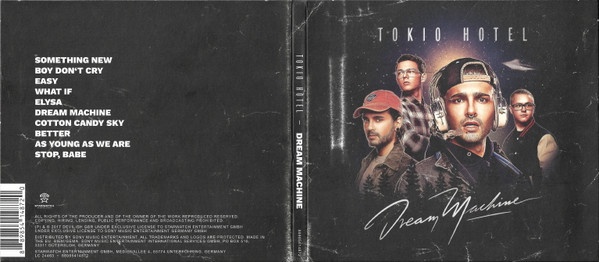
Bill Kaulitz’s distinctive voice was generously filtered through autotune on nearly every track, except for a few lines in ‘Something New’, the verses of ‘Better’, and the nearly acoustic ‘Elysa’. The production was either packed to the brim with synths, as in ‘As Young As We Are’, or deliberately airy and stripped-back, as in ‘Stop, Babe’, ‘Cotton Candy Sky’ and ‘Boy Don’t Cry’. The latter could easily slip into Bill’s solo project BILLY, it closely mirrors songs from his debut album ‘I’m Not OK’, like ‘California High’.
One of the album’s clear standout moments was the potential hit ‘What If’, a track that combined catchiness, an irresistible rhythm, and arrangement nods to the timeless 80s. There was even a moment of déjà vu thanks to its shared title with a Coldplay song, though that was more of a passing coincidence.
Still, one of the most affecting tracks on ‘Dream Machine’ remains ‘Easy’. Both its lyrics and energy carry something personal and unresolved stronger than on any other song in the release. Yet the track feels restrained: it’s crying out for powerful, even if electronic, beats, but the band seems reluctant to let go, to shout at full volume. That’s not allowed, it seems. Shouting is for teenagers. And by then, Tokio Hotel were grown-ups. And grown-ups, as we know, are expected to be more restrained.
Could one have expected back then an expansion of the audience thanks to fans of mainstream pop and synth sound? Theoretically yes: performers in these genres are often interchangeable, both in playlists and in the minds of music lovers. But once you blend into the crowd, it’s strange to expect that you’ll be singled out.

The album opens with the track “Something New” and with lines that set the tone for the entire album. These words exhaustively convey the mood of the record. “Dream Machine” invites you to see it as the work of grown, accomplished people who have found harmony with themselves and with the world. But achieving that is difficult. Tokio Hotel tried to distance themselves from the depressive teenage image of their early work, but the lyrical protagonist of their songs, so to speak, still remains a person who has not found inner balance. This is no longer the teenager from the 2000s, but neither is it a mature, calm personality. It is still the same search simply in a new, modern musical wrapping.
Yet for someone who already understands everything, there is no point in creating. And who will even listen to this? After all, for listeners, other people’s mistakes are most relatable especially when they resemble their own so closely. A creative person is, above all, a restless and searching nature.
And in this search even with failures, doubts, and changes of direction Tokio Hotel keep moving forward. This deserves respect. The space-and-travel aesthetic that accompanies the visual side of the album matches perfectly with the futuristic, “floating” sound. “Dream Machine” is ten tracks in fashionable wrappers, a little naive, a little enigmatic, and just as dreamy as the gaze of a person turned toward a sky the color of cotton candy.
 Bisquiet: Gaming, Music, Celebrities, Reviews, and Entertainment News.