


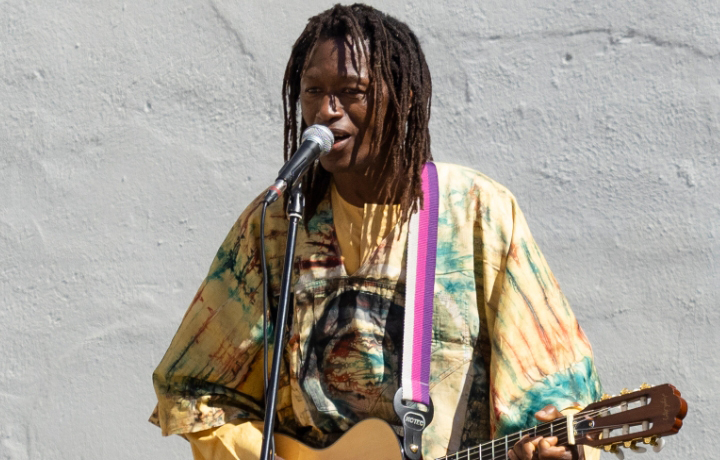
Music means different things to different people. For some, it’s just something fun to listen to. But for others, like Daouda Diabaté, it’s a lifelong conversation, a way to connect with heritage, family, and the world around us.
Daouda’s story started quietly, with secret moments playing his grandfather’s 21-string kora as a child. Since then, his journey has grown to include humanitarian work and making music that ties together cultures across continents. What really drives him is a deep commitment to keeping memory and tradition alive while making a positive impact.
In this interview, Daouda opens up about the early moments that set him on his path, how language and melody come together in his songs, and the meaningful ties he feels to his instruments and the people he works with.
Do you remember the moment you first picked up an instrument and thought — yes, this is where my path begins?
First of all, thank you for giving me the opportunity to do this interview with your magazine. Yes, indeed, I remember that when I was 7 years old, I secretly played my grandfather’s kora. It was a 21-string instrument that was like a large harp. It belonged to my maternal grandfather, who raised me. When he caught me playing the harp, he would look at me and smile.
And when I got my first guitar at 12, the funniest thing was playing it at night when everyone was in bed, in the middle of the night, in the silence of the night. The sound sometimes reached places you can’t imagine.
When you return to Senegal, what’s the first thing you want to do — hug your loved ones, play music, or simply listen to the sound of your homeland?
You know, when I go back to Africa, Senegal, my time is too limited, between my family, my band, my hotel, and my humanitarian organization, The Windows of SMILE. Sometimes I go back to Europe without having done everything I wanted to do, but I like to be busy. We dug wells last year for villages that have difficulty getting drinking water, and I couldn’t attend the inauguration and had to return to Europe.
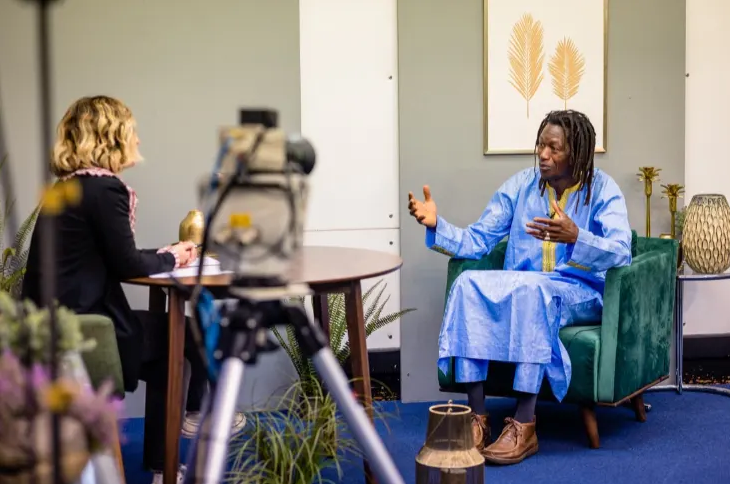
You sing in several languages. Are there times when the melody itself tells you which language it wants to be sung in?
You’re right, sometimes it’s the melody that guides the song, and the choice of languages as a medium, to convey the messages I want to convey. And for me, it’s also important to make myself heard through languages, so that the messages can reach their recipients.
Which instrument do you feel the closest connection with — the one your hands reach for even in silence?
You know, the first instrument that fascinated me the most is the human voice. It is one of the receptacles of magnetic gravity that nature has given to humans because everything in the universe is made up of waves and frequencies. We speak and emit sounds, and the power of the word was the beginning. We use as a medium the 7 degrees of musical scales, which are sounds that resonate on different frequencies and connect to waves across the universe that can touch the sensitivities of all souls who breathe the air of the time. Of course, I play different instruments, but I am fascinated by this beautiful gift that nature has given us, which is the human voice. In my house in Africa, I have visits from birds singing in the garden all day long, and I love listening to them sing all day long.
If you could perform a concert anywhere in the world — on an ocean shore, in the mountains — where would you want to be?
You know, I’m connected to these two geographical locations, the mountains and the sea. I’ve always lived nier of the sea in Africa, and in Europe, I live by the mountains, a peaceful atmosphere so as not to lose my identity with the modernity of Europe, and above all, to connect with myself and be in contact with nature, to breathe clean air, just like living by the sea, you breathe very pure air. You know, playing concerts is like honoring contracts, and I like to honor my commitments with promoters. Playing in big cities, in the mountains, or by the sea gives me the same energy to honor my commitments with promoters and festivals.

When working with different musicians, what matters most to you in a person — technique, soul, sense of rhythm?
When I work with musicians, the most important thing for me is sharing and that each musician can come out of the collaboration or stay in the collaboration grown and have more experience for their career, because I bring a musical support that is all new to them, a new style of music, new in terms of rhythm and sounds, so I share with them another musical horizon that they did not know before. Managing musicians or a music group is like managing your own family. Honesty must be at the center, which means you have to be honest with everyone and manage the psychology of each of the musicians.
You often speak about preserving memory and tradition. Is there a personal story you haven’t yet turned into a song but dream of doing so?
Yes, indeed, preserving cultural memory allows us not to lose ourselves, and to lose our identity in the face of modernity, which is all based on purchasing power, and a spiral of accumulating treasures and materials to appear important, even committing crimes against humanity, and then ennobling them. For three years, I’ve dreamed of reviving the memory of my grandmother, who was a Manding singer descended from the Kouyates lineage, queen of the griots in the ancient Manding empire. She died two years ago. I was able to write a song to revive her memory, which I recorded with my band and will be on the fourth Tama Silo album that we are currently recording in Europe.
What inspires you the most — travel, meeting people, or maybe silence?
For my part, I draw a lot of inspiration from silence. In calm, the mind travels and circles the globe in a fraction of a second, and we have clarity about the things and themes we want to address. I give myself the opportunity to capture each sentence, each word that the universe inspires in me and that I must deliver to paper so that it doesn’t evaporate. My encounters and my travels open my eyes to understand what’s happening around me and to experience things, and to be able to enter the soul of the songs I write, to enter the skin of those for whom my songs are intended.

When someone hears your performance for the first time, what feeling do you hope they walk away with after the concert?
Like all musicians, we want to give the best of ourselves in our concerts. For us, the Dialys Griots, music is very sacred and must be measured to cross borders and barriers, captivate the soul, and ultimately make love and peace flourish in the world. the public who comes to see our concerts, not only music must be a vehicle to give joy and happiness during the 1h30mn concert, but also, we offer after these 1h30mn concerts to these people present in the concerts, or those who could not come to the concert, who have difficulty reaching the end of the month or in precarious situations, help them with the funds collected from the concerts so that they can have stability in their daily lives and chase away the fear and worry of what worries them, so that they can have the certainty that they are not alone, this is the project of the WINDOWS OF SMILE music festival that we would like to organize in all the municipalities of the cities to help people socially, because the happiness of human beings is not limited to 1h30mn of concerts of vibrations and happiness to fill the void and the daily need of human beings.
Have you ever had a moment on stage where everything around you paused — and the music felt like it already knew where it wanted to take you?
You know, music is magic. Those who understood it used it to popularize content they wanted to promote and reach different audiences.
I remember when I met my first producer, he asked us to do a series of concerts before going to play in Paris. We had to open for a band that was very famous at that time. When we were on stage, I remember the audience was made up of wealthy people. The performence seemed captivated and mesmerized. At the end of the concert, the leader of the band we opened us to come to play ,came to see me on backstage and frankly told me that he thought we shouldn’t open for a band; we should organize our own concerts because he thought we had worked hard.
And then we collaborated with the Belgian government to support an intercultural mediation project to help disadvantaged children, children who lived on the streets, so we released our first album, called Intercultural Mediation.
 Bisquiet: Gaming, Music, Celebrities, Reviews, and Entertainment News.